Tesla Thinks Smaller and Faster—Geely Thinks Like a Taxi Operator From The Future
By Hugo Mattson April 27, 2026

Tesla Cybercab focuses on low-cost, high-frequency trips, while Geely EVA Cab is built for broader real-world use.
Tesla’s two-seat layout limits flexibility, while Geely supports more passengers and trip types.
Tesla bets on autonomy and scale, while Geely focuses on controlled fleet deployment.
Two Ways to Build a Robotaxi:
Tesla vs Geely The concept of the robotaxi has evolved from one single idea to two separate ideas that continue to remain in competition with each other. One is the Tesla Cybercab; a completely new, self-driving vehicle that incorporates cost and software into its design. The other is the Geely EVA Cab, a vehicle designed specifically for the way people currently book ride-hailing services. Both types of vehicle are driverless. However, how each vehicle incorporates a replacement for a driver differs significantly.
Tesla Starts With the System
A two-seat, fully autonomous vehicle with no wheel or pedals, Tesla's Cybercab is designed to function as part of a larger network of vehicles that leverage scale and frequency to provide autonomous driving at a low cost. The simple logic behind this: - Keep the car inexpensive, - Keep it in-service as often as possible, - Let the number of rides compensate for the lower fare. This model will work if most trips are short and solo, which is often the case in most urban areas. However, it also limits the vehicle to a very specific use case – two passengers, little to no cargo, fast turnover to the next passenger – and once you start to vary from that, you'll run into some major issues!
Geely Starts With the Ride
Like a regular taxi, the EVA Cab by Geely has been designed in a manner that will allow for its direct replacement as a taxi. The cab is built tall and upright, can be easily accessed, and is designed for many different types of journeys. Passengers can fit in comfortably, and there are many choices with few limits while operating the cab on a daily basis. Geely will deploy these vehicles through its Caocao ride-hailing service, with a wide rollout planned over the next several years.
Where They Split
Autonomy is not the primary difference between Tesla and Geely; rather, each of these companies is optimizing for a different set of objectives. Tesla would like to maximize throughput: the number of trips taken, the cost per mile, and the frequency of use. In contrast, Geely would like to maximize utility: the number of passengers transported per trip, the range of trip types, and the predictability of their fleet's usage. These differences are evident in the two types of vehicles produced by these companies.
Side-by-Side
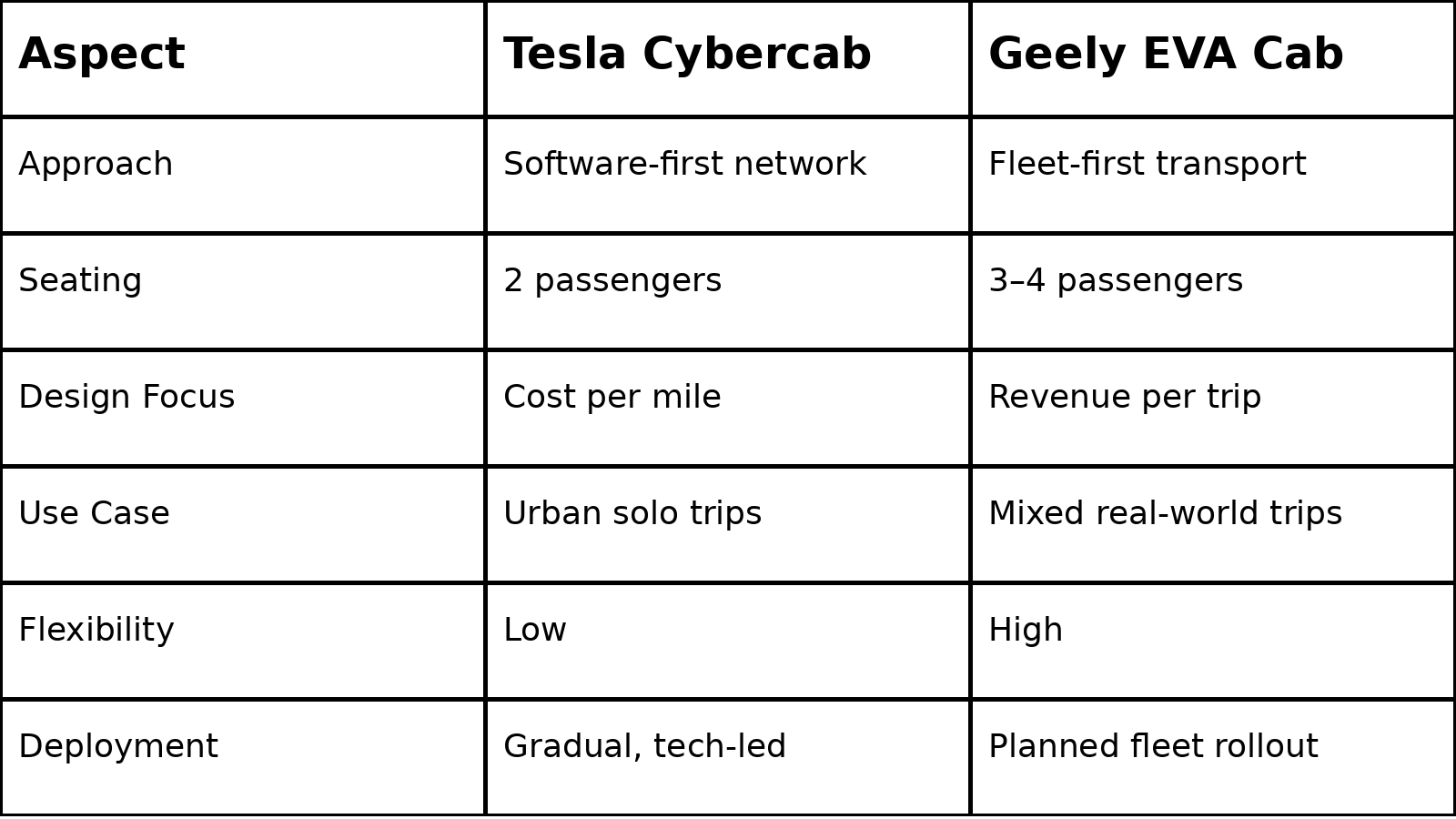
Concerns over the Cybercab
Most concerns regarding the two seats in a Cybercab stem from concerns over how practical it is. Taxi cabs perform many functions including being used for airport transport, providing transport to small groups, and shared cabs (group activities). Because there are two seats in the Cybercab, the other capabilities are missed out on because of space restrictions. Tesla believes they can solve this with volume. More cabs will equate to more trips. This will only succeed if the number of consumers meets the requirement.
Two Individual Risks
Tesla’s Dependencing On:
Autonomy utilising at scale
Regulatory approval
Demand remaining individual
Geely’s Dependencing On:
Fleet execution
Cost control
Consistent growth
The Straight Take by DailyRevs
With This, Tesla Will Build The Network And Create The Car To Match It.
With This, Geely Will Build The Taxi And Create The Systems To Support It.
Both Will Work, Because They Solved The Problem.
At This Time, One Can Fit More Instances Out Of The Box.