Mahindra Lifestyler vs Toyota Hilux: Why Toyota Should Watch
By Hugo Mattson September 4, 2026

Mahindra plans to sell the Lifestyler across Australia, South Africa, Africa, the Middle East and Latin America, putting its new pickup into several markets where the Toyota Hilux has been established for decades.
The Lifestyler deliberately looks and feels like a proper truck, combining Mahindra's long experience with diesel-powered utility vehicles with the comfort and technology expected from a modern double cab.
Toyota still has an enormous advantage in reputation, dealer support and resale value, but Mahindra doesn't need to beat the Hilux outright. A capable truck at the right price could be enough to make buyers question the Toyota premium.
Toyota May Want To Keep An Eye On Mahindra's New Hilux Rival
The Mahindra Lifestyler is heading into Toyota Hilux territory with rugged styling, plenty of diesel experience and a global expansion plan aimed at some of the world's biggest pickup markets.
Mahindra has a new pickup on the way, but what's particularly interesting is where it intends to sell it. Australia and New Zealand are on the list, along with South Africa, other parts of Africa, the Middle East and Latin America. These are all markets where the Toyota Hilux has spent decades building a formidable reputation.
.jpg)
Simply showing up in Hilux territory doesn't make the Lifestyler a serious rival, of course. Toyota's position has been built over generations of trucks, and that sort of trust isn't something Mahindra can replicate with a new model, an attractive price and an ambitious expansion plan.
Still, Mahindra isn't exactly arriving empty-handed. It has decades of experience building rugged utility vehicles, a well-established diesel business and an existing pickup presence in some of these markets. The Lifestyler also suggests Mahindra understands something rather important about the people it hopes to sell this truck to.
You only have to look at it.
It looks like a truck because it's supposed to
Mahindra could easily have taken the Lifestyler in a much more futuristic direction. The BE 6 and XEV 9e have already shown what its designers are capable of, while the design operation led by Pratap Bose across India and the UK certainly isn't short of ideas. The fact that the Lifestyler looks relatively conventional by comparison therefore seems deliberate.
It's a big, square truck with a tall bonnet, an upright face, huge wheelarches and plenty of visual bulk. There isn't much effort to make it look sleek, and that's probably the point. The Lifestyler doesn't look like an SUV with a load bed added to the back. It looks like something you'd be quite happy to get dirty.
.jpg)
There's still enough polish to keep it from looking agricultural, but not so much that the basic character of the truck gets lost. The three versions Mahindra has shown so far play with that formula rather than changing it. Valley has the more work-oriented appearance, Reef leans towards recreation, while Trail pushes further into the off-road and adventure side of things. They're different interpretations of essentially the same rugged design.
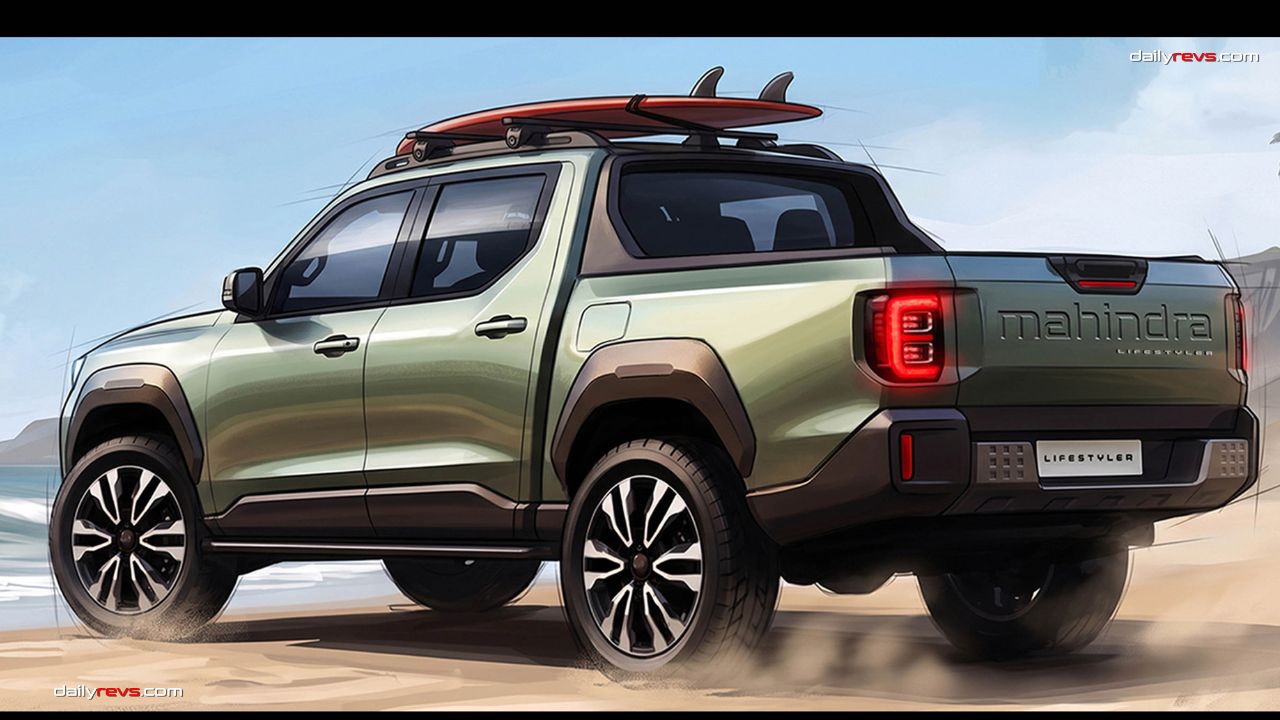
That's more significant than it might sound, because pickups have been moving steadily in the opposite direction. They're quieter, more comfortable and better equipped than ever, and many now work perfectly well as family cars. But that extra sophistication has also made some of them look and feel increasingly like SUVs.
Mahindra seems to have decided that making a pickup more comfortable doesn't necessarily mean making it look less like a truck. There are probably plenty of buyers who will appreciate that.
Mahindra knows its way around a diesel
Then there's the engine side of the story. Mahindra isn't a newcomer that suddenly decided there was money to be made in pickup trucks. It has been building utility vehicles for decades, and its mHawk diesel family has been around since 2007, powering everything from the Scorpio and Thar to XUVs and the Pik Up.
That experience should count for something in places such as South Africa, Australia and the Middle East, where plenty of pickups are still bought with actual work in mind. We don't know the final international powertrain specifications for the Lifestyler yet, so calling it bulletproof before customers have even driven one would be getting well ahead of ourselves. But Mahindra's approach to its existing workhorses does offer a few clues.
.jpg)
Take the South African Pik Up. Mahindra recently switched some versions from a dual-mass flywheel to a simpler single-mass setup, citing improved durability and lower maintenance costs. It's hardly the sort of change that makes headlines, but if you're paying the repair bills on a truck that works every day, it probably matters more than another 20 horsepower.
It will be interesting to see how much of that thinking carries over to the Lifestyler. It'll still need the screens, cameras, safety systems and other equipment buyers now expect from a modern double cab. The challenge for Mahindra will be adding all of that without making the truck underneath needlessly complicated.
South Africa could be the interesting test
South Africa gives us a pretty good idea of what Mahindra might be capable of outside India. The company has been operating there since 2004 and already assembles its Pik Up in Durban. The current truck isn't exactly new either, yet buyers are still turning up for it. In 2025, Mahindra sold 7,568 single-cab Pik Ups, enough to put it third in the segment behind the Toyota Hilux and Isuzu D-Max.
The rest of Mahindra's South African business has been growing quickly as well. It sold more than 18,000 vehicles last year, an increase of over 40 percent, while its market share has risen from just 0.7 percent in 2018 to more than 3 percent. Over roughly the same period, its dealer network has expanded from 55 locations to more than 100.
.jpg)
Toyota is still playing in a different league. More than 36,000 Hiluxes were sold in South Africa in 2025 alone, so Mahindra isn't about to knock it off its perch. But there's something interesting about a much smaller competitor steadily building sales, dealers and local production in the background.
More importantly, Mahindra has managed that growth with an ageing pickup. The Lifestyler gives it something it hasn't really had before: a modern pickup developed from the outset with international markets in mind. That's what makes South Africa worth watching.
Mahindra doesn't seem particularly intimidated by bigger companies
This isn't the first time Mahindra has pushed a product beyond what people expected from the brand. The Thar could easily have remained a fairly basic off-roader, but Mahindra turned it into a genuinely desirable lifestyle vehicle. The Scorpio-N followed a similar path, taking a familiar rugged SUV considerably further upmarket without completely abandoning what made the original popular.
More recently, the BE 6 and XEV 9e showed another side of the company. Both were considerably more ambitious in terms of design and technology than many would have expected from Mahindra a few years ago. The Lifestyler feels like the next step in that progression, except this time Mahindra is taking the idea to a much bigger international audience.
It doesn't appear to be trying to out-Toyota Toyota either. Mahindra is sticking with things it already understands: rugged vehicles, diesel experience and, almost certainly, pricing intended to make buyers look twice. The difference is that it's now packaging those ingredients into a pickup designed from the outset to travel well beyond India.
The Hilux doesn't need another killer
Let's not call the Lifestyler a "Hilux killer." The internet already has enough of those, and besides, the hardest thing for Mahindra to compete with isn't the Hilux's engine, towing capacity or equipment list. It's everything that doesn't appear on the spec sheet.
There are Hilux owners who know exactly what these trucks can take because they've owned several of them. Mechanics know how to fix them, fleet operators understand their running costs, parts are easy to find and resale values benefit from the reputation Toyota has spent decades building. Mahindra can't shortcut any of that. It has to earn it.
Where things could get interesting is price. The Scorpio Lifestyler is due in India by April 2027 with a starting price below ₹19.79 lakh. We don't know what it will cost in South Africa, Australia or the Middle East, and simply converting the Indian price into local currencies wouldn't tell us much. But Mahindra competing aggressively on value would hardly be a surprise.
More importantly, the Lifestyler doesn't necessarily have to be better than the Hilux for that strategy to work. A buyer only needs to like the way it looks, feel comfortable with the diesel underneath it, find the equipment and capability convincing, and have reasonable confidence that Mahindra can support the truck after the sale. Then comes the price.
If the difference is large enough, the question changes. Instead of asking whether the Mahindra is better than the Toyota, buyers may start wondering whether the Toyota is worth the extra money. That's the opening Mahindra is looking for.
.jpg)
There is still plenty we don't know. Final specifications haven't been announced, overseas pricing remains a mystery and, most importantly, the Lifestyler hasn't had the chance to prove itself in the hands of owners. Toyota has decades of history on its side, while Mahindra still has a reputation to build in many of these markets.
What Mahindra does have is plenty of diesel experience, an existing pickup business, designers who seem to understand what their audience wants and a management team that isn't particularly shy about aiming high. Now it's taking that combination into some of the Hilux's favourite markets.
Toyota doesn't need to panic, but checking the mirrors wouldn't hurt.
Sources :