As The Smart Fortwo Returns, UVESTO Has A Different Idea
By Hugo Mattson September 30, 2026

Paweł Olszewski's UVESTO is a two-seat electric city car concept designed around the changing needs of urban environments.
Its extendable rear section can accommodate bicycles and other everyday needs without permanently increasing the vehicle's footprint.
The concept arrives as the Smart #2 revives the Fortwo formula and tiny EVs such as the Citroën Ami, Fiat Topolino, Wuling Mini EV and MG Comet explore very different solutions to urban transport.
The Smart Fortwo disappeared just as the cities it was designed for started becoming more hostile to large cars.
Two years later, Smart wants its tiny two-seater back.
The new Smart #2 will make its production debut in Paris this October, effectively picking up where the Fortwo left off. It is electric, less than three metres long and once again built around two people rather than trying to squeeze a conventional small car into a slightly shorter body. Smart itself describes the #2 as an evolution of its iconic two-seat city car.
The timing is interesting because the Fortwo idea hasn't exactly been sitting unchallenged.
The Citroën Ami and Fiat Topolino have gone smaller and simpler. China turned the tiny EV into mass transportation with the Wuling Hongguang Mini EV, while the related MG Comet EV packages four seats into less than three metres of car in India. Renault has brought back the Twingo as an EV, and Nissan has just revived the PIXO name for another electric city car.
Apparently, the small car isn't finished after all.
.jpg "uvesto-electric-city-car-concept-pawel-olszewski")
Which makes Paweł Olszewski's UVESTO feel particularly well timed.
It isn't a proposal for the next Smart, nor is it trying to be. Instead, Olszewski has taken the basic problem that created cars like the Fortwo and approached it from a different direction.
His starting point is simple:
What if urban mobility was designed around people, rather than around cars?
UVESTO Doesn't Start With A Conventional Car
Cities across Europe and elsewhere are changing. More space is being allocated to pedestrians, bicycles, public areas and alternative forms of mobility, while cars themselves have generally been moving in the opposite direction.
They have become bigger.
Olszewski doesn't argue that the car should disappear. Quite the opposite. His reasoning acknowledges something public transport and bicycles cannot completely replace: the freedom and flexibility of having a car available when you need one.
The question is how much car you actually need to provide it.
UVESTO is his answer..jpg "UVESTO Electric City Car Side Profile by Paweł Olszewski")
It is a compact two-seat electric vehicle designed specifically around urban life. Rather than taking everything expected of a conventional passenger car and trying to squeeze it into a smaller package, the concept concentrates on two occupants and makes the rest of the vehicle work around them.
That thinking is immediately visible in the proportions.
The wheels sit close to the corners. The nose is extremely short. A huge windscreen rises into the roof and leaves the passenger compartment occupying much of the vehicle's overall length.
There are similarities in philosophy to the Fortwo, inevitably.
.jpg "UVESTO Electric City Car Front Design by Paweł Olszewski")
But visually, UVESTO goes its own way.
A Tiny EV That Isn't Pretending To Be An SUV
One of the more refreshing things about Olszewski's design is what isn't there.
UVESTO doesn't have oversized fake intakes, chunky pseudo off-road cladding or the usual collection of SUV cues intended to make a small vehicle appear larger and tougher than it really is.
Olszewski deliberately describes the design language as friendly and approachable.
The sketches show how he arrived there.
.jpg "UVESTO Electric City Car Design Development and Bicycle Carrier")
Early explorations play with simple geometric masses before gradually developing the distinctive relationship between the large glazed cabin, compact body and wheels. The final design retains that simplicity rather than covering it with decoration.
From the front, UVESTO looks surprisingly planted for something so small. The wheels are pushed outwards and remain visually prominent, while extremely thin horizontal lighting runs beneath the windscreen.
The side is even more distinctive.
.jpg "White UVESTO Two-Seat Electric City Car by Paweł Olszewski")
The dark glasshouse forms one large graphic, the orange body another, and the contrasting lower rear section effectively becomes a third. The two-tone treatment is important to Olszewski's original idea, connecting different areas of the vehicle and giving the little EV an identity without relying on unnecessary detailing.
It looks friendly without looking like a toy.
Then you reach the back.
.jpg "UVESTO Electric City Car Rear Design by Paweł Olszewski")
And that is where UVESTO becomes much more interesting.
The Back Of UVESTO Actually Changes
Small cars have an obvious problem.
They're wonderfully small until you need them to carry something big.
.jpg "UVESTO Electric City Car Rear Cargo Area")
The conventional solution has been predictable: add more boot space, add another row of seats, increase the wheelbase and make the car longer.
Eventually, the tiny city car isn't particularly tiny anymore.
Olszewski has gone the other way.
UVESTO has a flexible rear area that can change according to what its owner needs to carry.
The design illustrations show the lower rear section extending backwards from the main body. In normal use, it remains tucked against the vehicle, preserving the extremely compact footprint. When additional carrying capacity is needed, it slides out.
One of Olszewski's most interesting illustrations shows exactly what that extra space could be used for.
Two bicycles.
.jpg "UVESTO Electric City Car With Extendable Bicycle Carrier")
Instead of making UVESTO permanently larger because its owner might occasionally need more room, the car only takes up that additional space when it is actually required.
It's a relatively simple idea, but one that changes the logic of the vehicle.
The Bicycle Is Part Of The Journey
The choice of bicycles isn't incidental either.
Cars and bicycles are frequently treated as competing solutions to urban transport. UVESTO imagines them working together.
Someone might drive part of a journey before continuing by bicycle. A cyclist could use the car to reach somewhere outside the city. Or the vehicle could simply transport bikes without requiring its owner to buy something substantially larger for the occasional weekend trip.
The car doesn't have to complete every kilometre of every journey.
That is where Olszewski's original idea of adapting mobility to people rather than adapting people to cars becomes much easier to understand.
And it also shows why UVESTO isn't simply another Smart Fortwo interpretation.
The Smart #2 continues to explore how good a dedicated two-seat city car can become.
UVESTO asks whether that little car could play a different role altogether.
Everyone Has A Different Answer To The Tiny EV
Look around the world and there is already plenty of evidence that there isn't one correct formula for a small electric car.
The Citroën Ami and Fiat Topolino strip the idea almost to its essentials. They are electric quadricycles rather than conventional passenger cars, intended primarily for relatively short urban journeys.
The Topolino is only around 2.5 metres long. It doesn't need to pretend that it can replace every other vehicle in someone's life.
China's Wuling Hongguang Mini EV takes another approach. Its enormous popularity demonstrated that a very small electric car can move beyond novelty status when the packaging and price make sense for the market.
Then there is the MG Comet EV.
At just 2,974 mm long, the Comet manages to fit four seats inside. Its objective is almost the inverse of UVESTO's: get a surprising amount of conventional car into a remarkably small footprint.
That difference helps explain Olszewski's concept better than simply comparing dimensions.
The MG Comet asks how much car can fit into three metres. UVESTO asks how much car two people actually need.
Neither answer has to be wrong.
They simply start from different questions.
Even The Windshield Is Put To Work
The same philosophy appears elsewhere on UVESTO.
Olszewski has incorporated solar panels into the large front windshield area, allowing them to support battery charging while the vehicle is parked outdoors.
This isn't presented as some miraculous replacement for plugging the car into a charger.
It is supplementary energy..jpg "UVESTO Electric City Car Solar Charging System")
What matters from a design perspective is that Olszewski is putting an existing surface to work.
The windscreen already needs to be there. Its dramatic size already contributes significantly to UVESTO's appearance. Integrating solar collection into that area gives it another function without attaching an obvious panel somewhere else on the vehicle.
On a car designed around using as little space as reasonably possible, that makes sense.
The Smart #2 Makes UVESTO More Relevant, Not Less
There is some irony in the timing of all this.
When the Fortwo went out of production in 2024, it wasn't immediately replaced. Smart had moved into larger vehicles, and for a while it appeared that the little two-seater that established the brand might simply become part of its history.
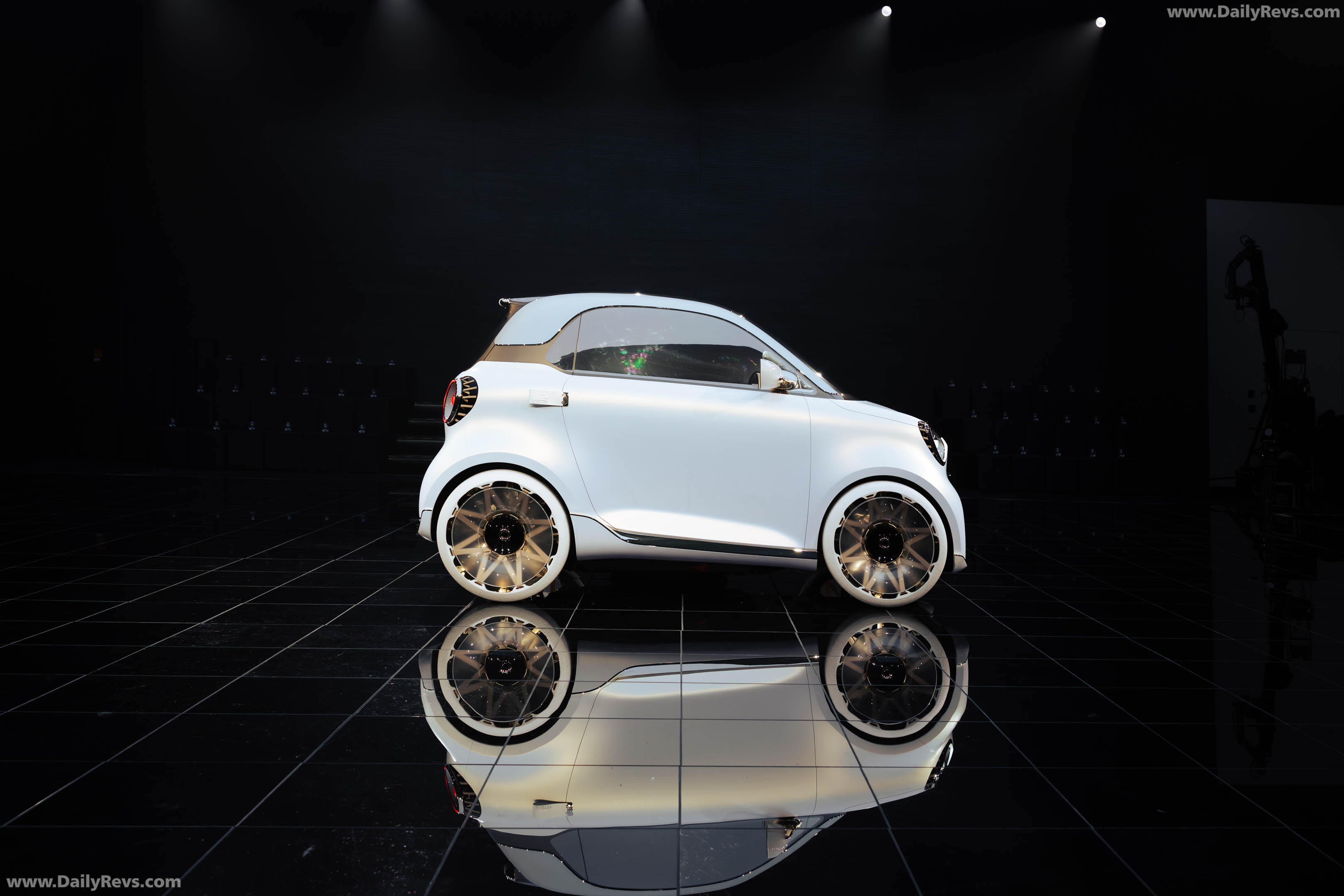
Now Smart is going back.
The Smart #2 is being developed on a dedicated electric architecture, remains a genuine two-seater and has been designed specifically around urban driving. Smart's latest information also confirms the return of its familiar Tridion safety concept in a new form.
Its arrival doesn't undermine the point of UVESTO.
It arguably makes the concept more relevant.
If Smart believes there is still room for a purpose-built two-seat electric city car nearly three decades after the original arrived, then the interesting question is no longer whether this type of vehicle deserves to exist.
It is what else it could become.
UVESTO Finds Another Way To Be Small
UVESTO remains an independent design study, so there is naturally a considerable distance between Olszewski's proposal and something that could enter production. An extending rear structure and integrated solar panels would bring their own engineering and cost considerations.
But the project is interesting because it approaches the familiar city car from a slightly different angle.
The Smart Fortwo built much of its identity around two seats and an exceptionally short footprint, something the upcoming Smart #2 is preparing to revisit. The Citroën Ami and Fiat Topolino have since pushed the idea towards even simpler urban transport, while the Wuling Mini EV and MG Comet show what can be achieved when more conventional small-car practicality is packed into a tiny body.
UVESTO sits somewhere between those approaches.
It retains the two-seat layout and compact proportions, but Olszewski has used the space behind the cabin differently. Instead of adding permanent length for occasional carrying capacity, the extendable rear provides additional room when it is needed, with the bicycle carrier showing one possible use.
The solar panels are another part of the same exercise, making use of the large glazed area to provide supplementary charging without fundamentally changing the shape of the car.
With small electric cars attracting attention again and the Smart #2 preparing to revive one of the segment's most recognisable names, UVESTO arrives at an interesting time.
It may never have to face the compromises of a production line, but Olszewski's concept shows there are still plenty of ways to interpret a very small electric car.
Connect with Paweł (Paul) Olszewski
To explore more of Paweł Olszewski's work, including ongoing projects and portfolio highlights, you can follow or connect with him on the following platforms:


