New Mitsubishi Pajero Returns With A Reputation To Defend
By Hugo Mattson September 4, 2026

The fifth-generation Pajero uses a heavily revised Triton-derived ladder frame, a 204 PS diesel, eight-speed automatic, low range, S-AWC and up to seven seats.
Pricing reveals a wider group of rivals than the Land Cruiser Prado alone, with the Ford Everest, Isuzu MU-X and, in some markets, Toyota Fortuner also competing for the same buyers.
Mitsubishi has produced more than 3.29 million Pajeros across four previous generations, while 12 Dakar victories and decades of use around the world have left the new model with plenty to live up to.
The Mitsubishi Pajero is back.
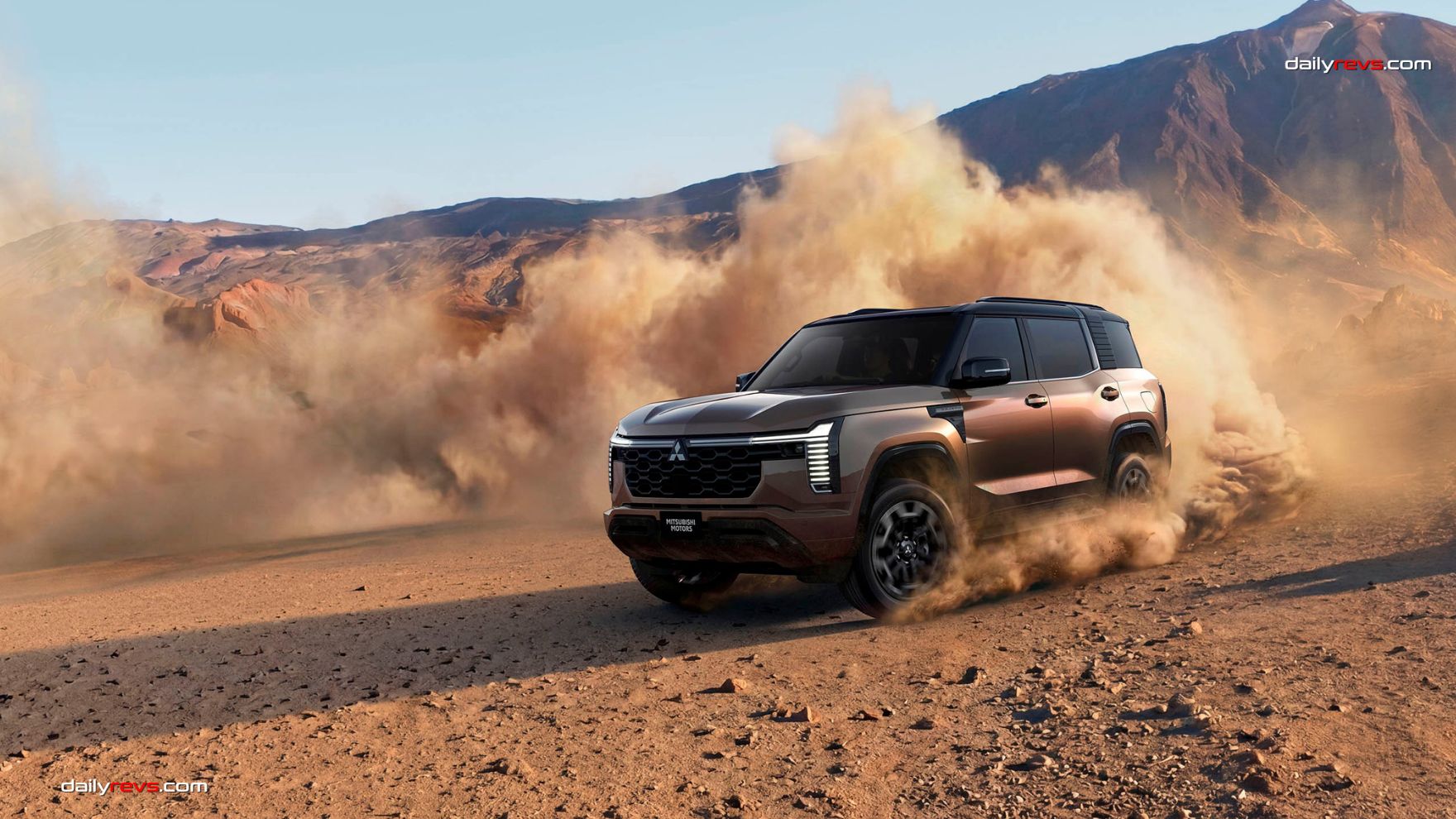
2027 Mitsubishi Pajero Gallery
Five years after production of the previous generation ended, Mitsubishi has introduced a fifth-generation model with a ladder frame, diesel engine, low-range gearing and a locking rear differential. It is also Mitsubishi's new global flagship. That combination makes the Pajero surprisingly difficult to place. Its engineering puts it among pickup-based SUVs such as the Ford Everest, Isuzu MU-X and Toyota Fortuner.
.
Its price and flagship status move it closer to the Toyota Land Cruiser Prado. Depending on the country, Mitsubishi could find itself competing with all of them. Australia gives us an early indication. The Pajero starts at A$68,490 before on-road costs, compared with A$58,990 for the Everest and A$73,200 for the Prado.
The Pajero GSR reaches A$84,990, taking it deep into territory occupied by better-equipped Everests and mid-range Prados. Mitsubishi therefore hasn't simply revived an old name and dropped it into its former position in the market. It has created something slightly different. And that may be appropriate, because the Pajero itself has never been particularly easy to define.
The Pajero became many different things around the world
The first production Pajero arrived in 1982. By the time the fourth generation finished production, Mitsubishi had built more than 3.29 million of them. The Pajero reached customers in more than 170 countries and regions. Those numbers help explain why memories of the vehicle vary so much depending on where you grew up. For some people, Pajero means Dakar. Mitsubishi entered the Paris-Dakar Rally with the vehicle in 1983 and took its first overall victory two years later. Pajeros eventually won the event 12 times, including seven consecutive victories.
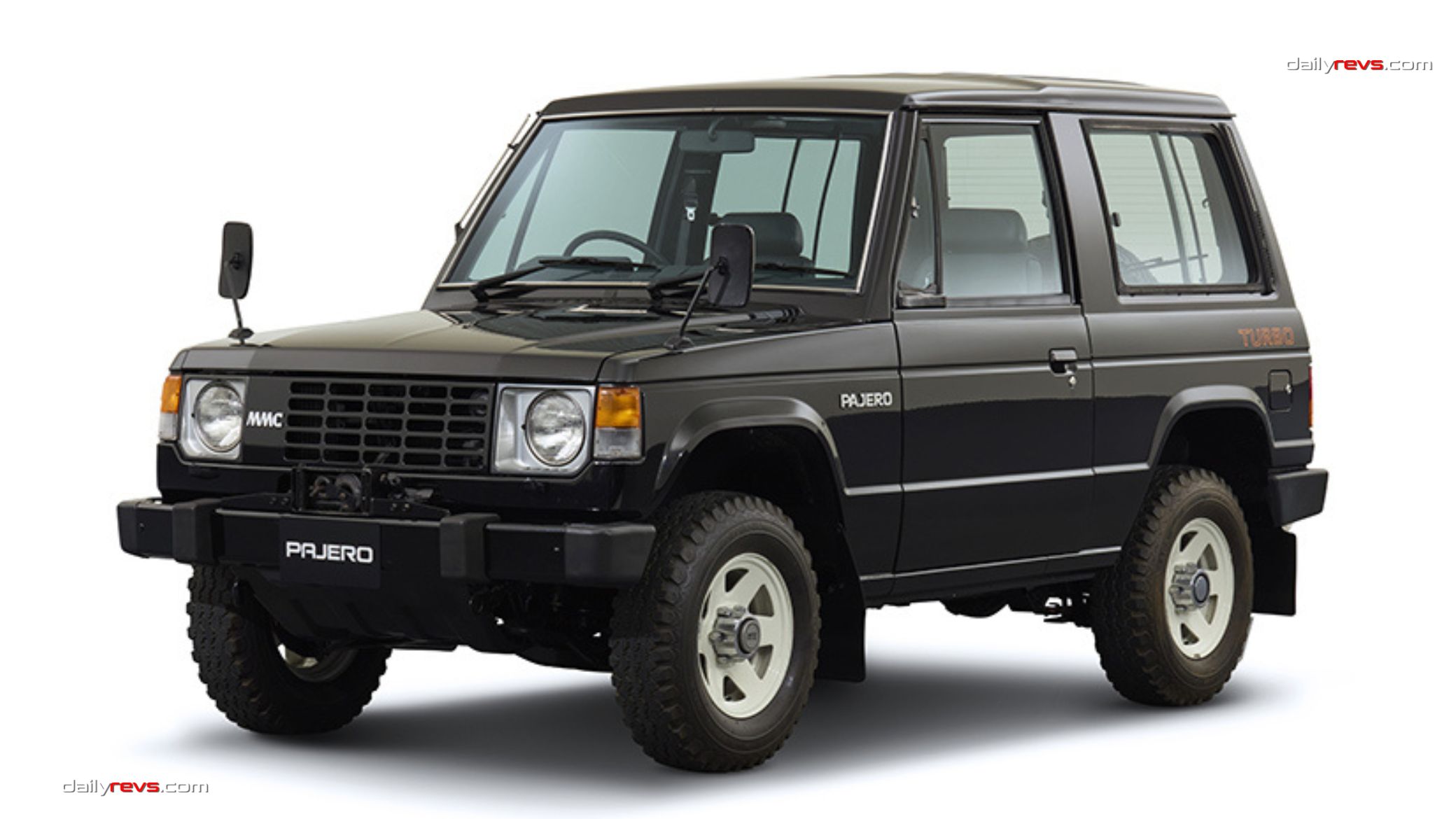
1982 Mitsubishi Pajero
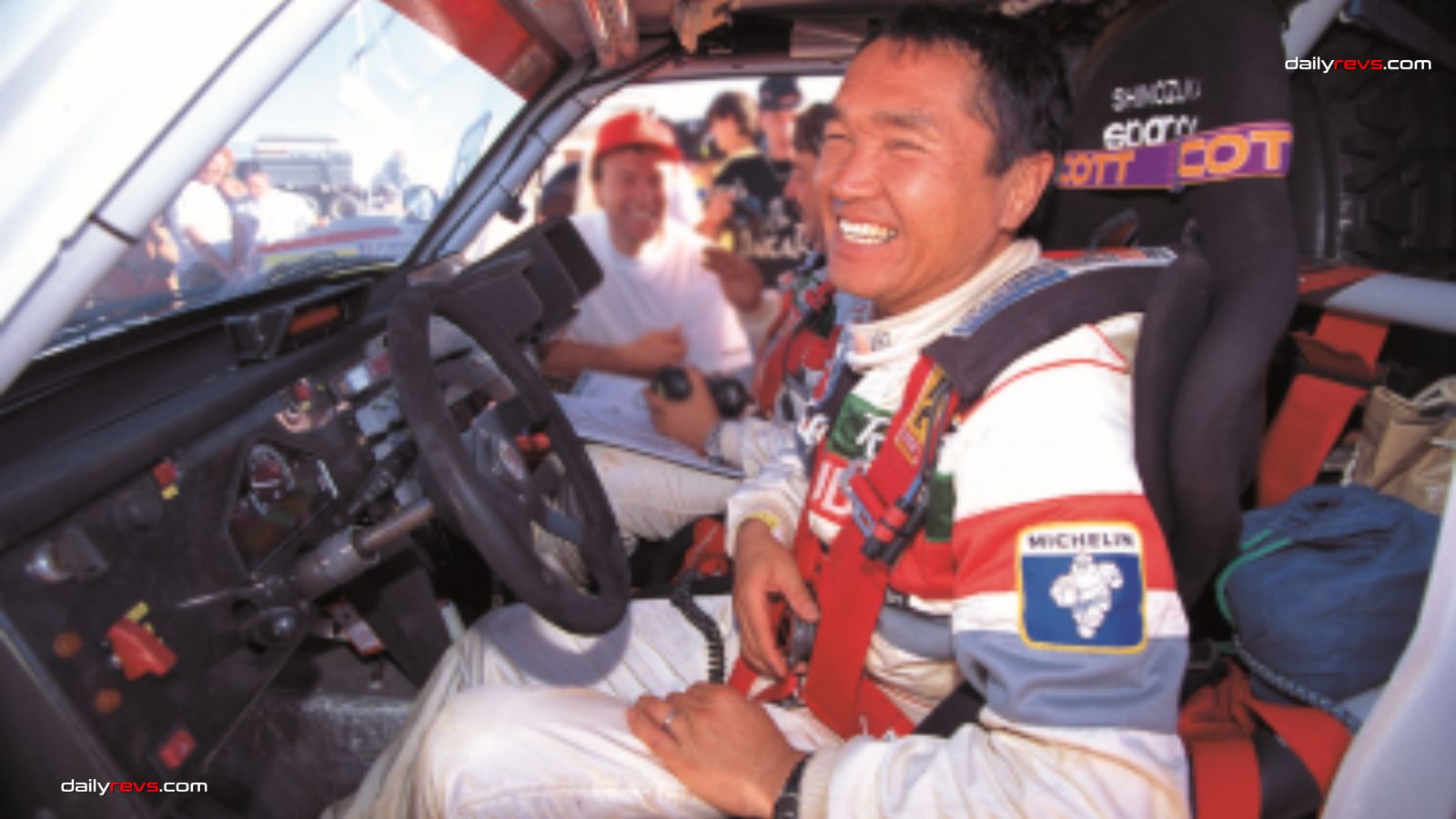
Stéphane Peterhansel became closely associated with Mitsubishi's dominance. Kenjiro Shinozuka became the first Japanese driver to win the Dakar in 1997. Hiroshi Masuoka won in 2002 and again in 2003. Then there was the Pajero Evolution, the extraordinary homologation model that brought some of Mitsubishi's competition thinking onto public roads.
But most Pajeros never saw a rally stage. They carried families, pulled trailers and went camping. Others became expedition vehicles or working transport. Some found their way into government and institutional fleets. Western Australia's government, for example, put a diesel Pajero into service in 2005 as its first fleet vehicle running entirely on biodiesel.
It was expected to cover roughly 45,000 km each year across the south of the state. Records from international organisations also document Pajeros being used in institutional fleets elsewhere. There is no need to exaggerate this part of the story. Not every dusty Pajero photographed in Africa, Asia or the Middle East was engaged in some extraordinary mission. Its usefulness was often far less dramatic. A large 4x4 with diesel power, four-wheel drive and the ability to cope with poor roads could simply be useful transportation. In some markets, that mattered more than image.
This Pajero starts with a Triton
The fifth generation returns to a ladder-frame chassis derived from the current Triton pickup. Ford does much the same thing with the Ranger and Everest. Toyota's Fortuner is closely related to the Hilux, while the Isuzu MU-X shares its basic architecture with the D-Max.
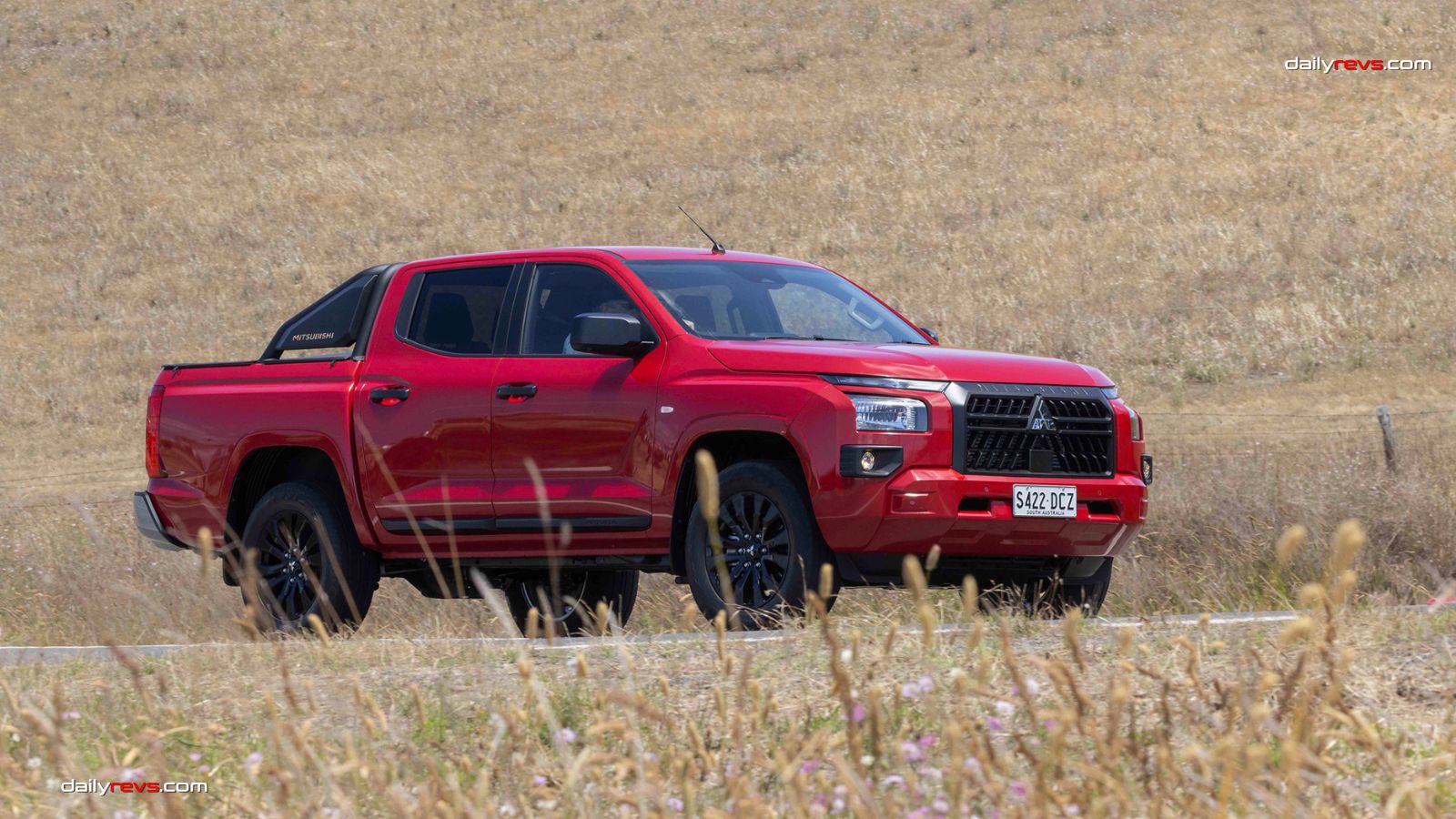
So the Pajero's engineering approach is hardly unusual for this part of the market. Mitsubishi has also done considerably more than place an SUV body on a Triton frame. The Pajero's wheelbase has been shortened to 2,870 mm. Mitsubishi says thicker frame side members and additional cross-bracing increase rigidity, while other areas of the structure were developed specifically for the SUV. Up front are double wishbones.
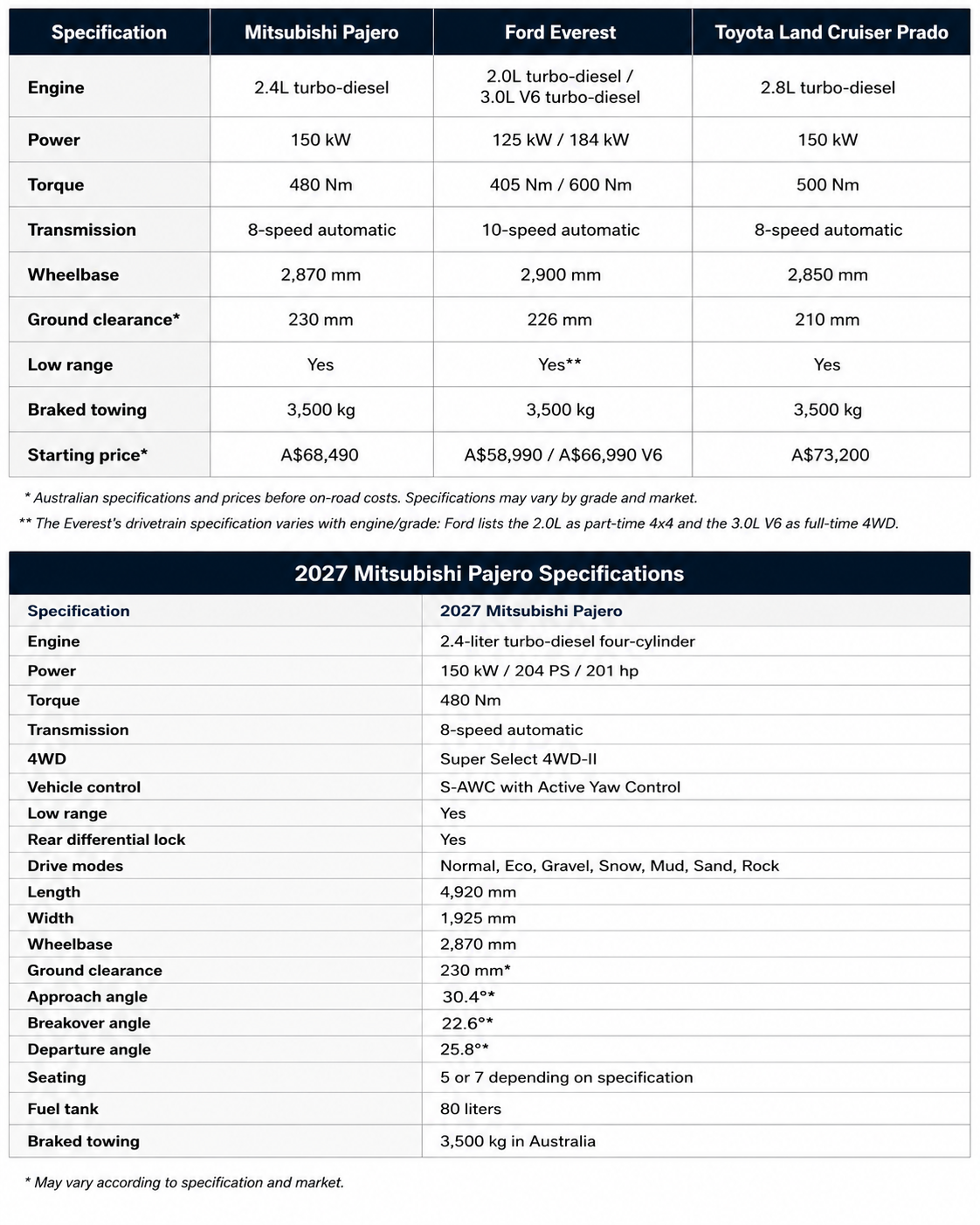
At the rear, the Pajero uses a five-link rigid axle with coil springs rather than the Triton's leaf springs. Rear disc brakes replace the pickup's drums, and Mitsubishi has spent considerably more effort on sound insulation and cabin refinement. The engine is familiar but has changed too. A 2.4-liter four-cylinder turbo-diesel produces 150 kW, or 204 PS, and 480 Nm. An eight-speed automatic replaces the Triton's six-speed transmission.
Then there is the four-wheel-drive hardware. Super Select 4WD-II allows rear-wheel drive, full-time four-wheel drive, locked-centre high range and locked-centre low range. There is a rear differential lock, while S-AWC adds Active Yaw Control. Seven drive modes cover Normal, Eco, Gravel, Snow, Mud, Sand and Rock. Ground clearance is 230 mm, with approach, breakover and departure angles of 30.4, 22.6 and 25.8 degrees respectively. These are useful numbers, but the more interesting comparison begins when price is added.
Prado, Everest or Fortuner?
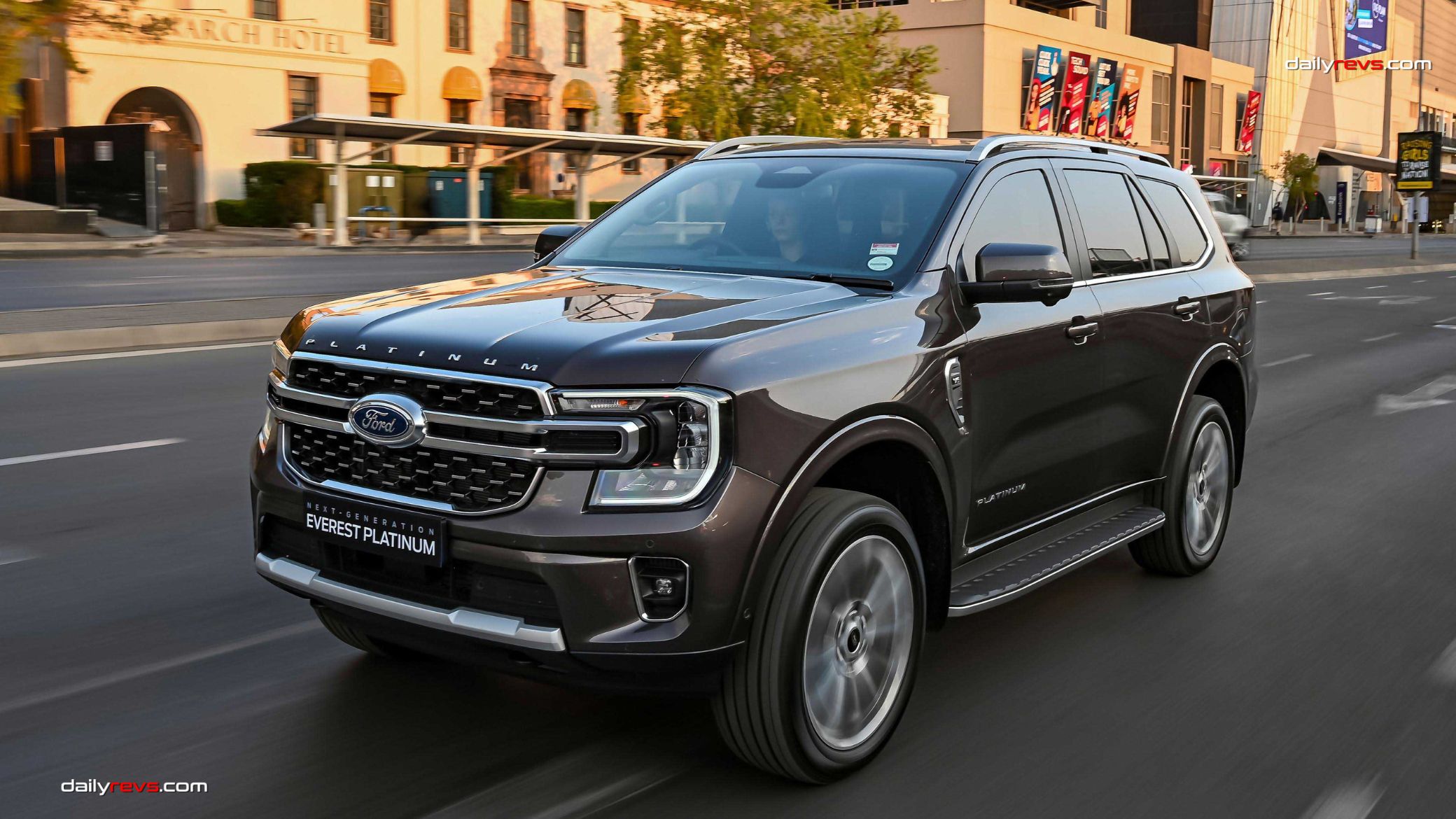
It depends where you live Calling the new Pajero a Land Cruiser rival isn't wrong. It is simply incomplete. In Australia, the A$68,490 starting price places the Pajero only A$4,710 below the entry Land Cruiser Prado. Move further up the Pajero range and Mitsubishi is asking A$79,990 for the Exceed and A$84,990 for the GSR. So Prado buyers are clearly within reach. But the Ford Everest may be the cleaner mechanical comparison. Ford starts with the Ranger platform and develops it into a three-row SUV. Mitsubishi is doing something similar with the Triton and Pajero. Both are built in Thailand. Both offer diesel power, low-range four-wheel drive and 3,500 kg towing capacity in Australia. Both have been developed to serve as family vehicles during the week while retaining enough hardware for much more difficult use.
The engines illustrate how neatly the Pajero falls between its rivals. Its 150 kW and 480 Nm beat the Everest's entry 2.0-liter diesel, but the Ford's available 3.0-liter V6 produces a much stronger 184 kW and 600 Nm. The Prado's 2.8-liter diesel produces the same 150 kW as the Pajero and slightly more torque at 500 Nm. The Isuzu MU-X sits further down the pricing ladder in Australia, starting at A$49,900, although its upper variants still compete for many of the same family 4x4 buyers. And then there is the Fortuner. It no longer forms part of Toyota's Australian range, but that doesn't make it irrelevant to a vehicle Mitsubishi intends to sell across ASEAN, Latin America, the Middle East and other regions.
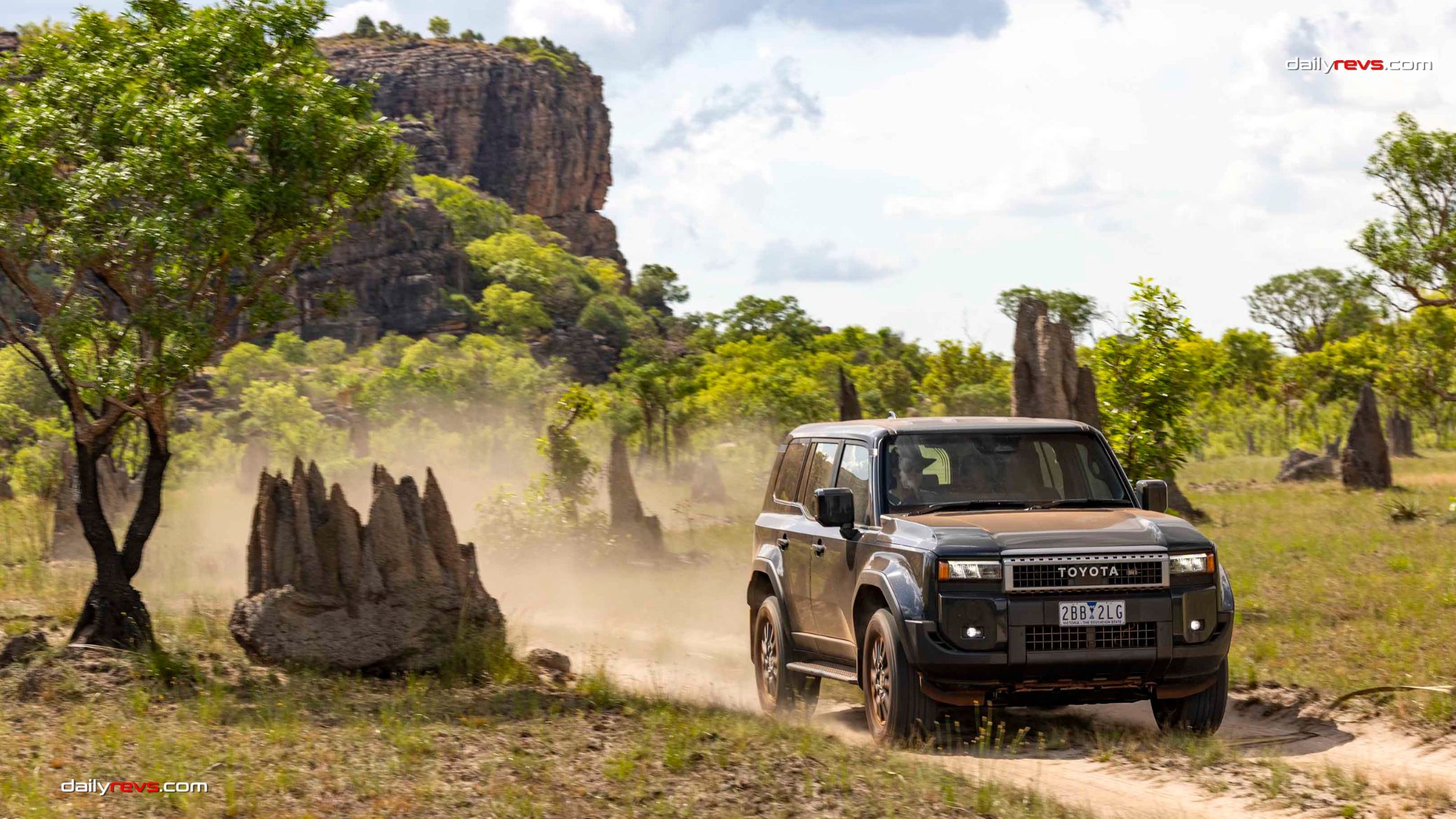
Where the Fortuner remains popular, the relationship becomes obvious: Hilux-based Toyota SUV against Triton-based Mitsubishi SUV, both offering three rows, diesel power and serious 4x4 hardware. There probably isn't one universal rival for the Pajero. Mitsubishi has positioned it above the straightforward pickup-based SUV formula without pushing it completely into Land Cruiser territory. That could become one of its strengths.
The new Pajero was designed during a very different Mitsubishi era
The mechanical story explains where the Pajero sits in today's market. Its design says more about how Mitsubishi wants to bring the name back. Alessandro Dambrosio joined Mitsubishi in 2018, following senior design positions that included Alfa Romeo, Maserati and Audi. As Executive Design Director, he became part of the leadership responsible for reshaping Mitsubishi's wider design direction. Dambrosio has since spoken about the attraction of helping rebuild a historic brand. When discussing Mitsubishi's history, he specifically pointed to the Pajero's 12 Dakar victories.
The new Pajero has arrived during that broader transformation. For the vehicle itself, however, Mitsubishi points directly to Norihiko Yoshimine, its Program Design Director. There is a personal connection here. Yoshimine has said the Pajero was one of the vehicles that inspired him to become a car designer. That makes his approach to the new one particularly interesting. Instead of choosing a favourite old Pajero and rebuilding its appearance around modern proportions, Yoshimine's team went looking for individual characteristics that could survive without making the entire vehicle look old. The result becomes easier to understand when the first-generation Pajero is placed next to it.
Look closely and the 1982 Pajero is still there
The new Pajero doesn't immediately look retro. But Mitsubishi makes no attempt to hide the historical references. The upright proportions and strong horizontal emphasis come from the first generation. Look at the C-pillar and another connection appears. Mitsubishi says its shape was inspired by the roll bar of the original Pajero. The rear is even more interesting. Older Pajeros became instantly recognisable from behind because of the spare wheel mounted to the tailgate. Mitsubishi hasn't put one there simply to recreate that appearance. Instead, the old spare wheel has effectively become a graphic.
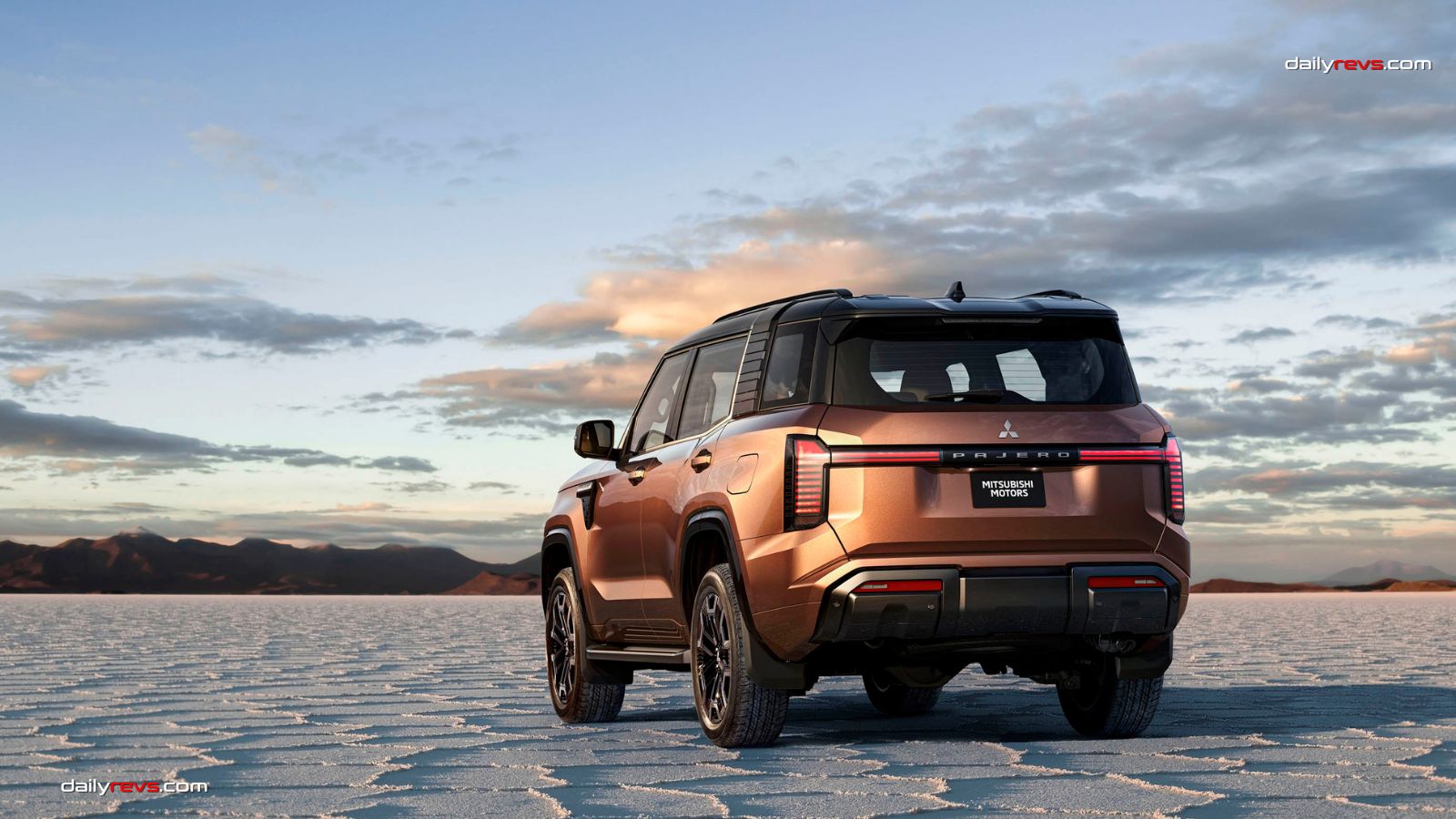
Its shape survives in the hexagonal treatment across the new Pajero's rear. The dashboard follows a similar idea. Its broad horizontal architecture references the original without trying to recreate a 1980s interior around modern screens. This is why describing the design as either retro or non-retro doesn't really work. Mitsubishi clearly looked backwards. It was selective about what it brought forward.
The three gauges may be the cleverest part
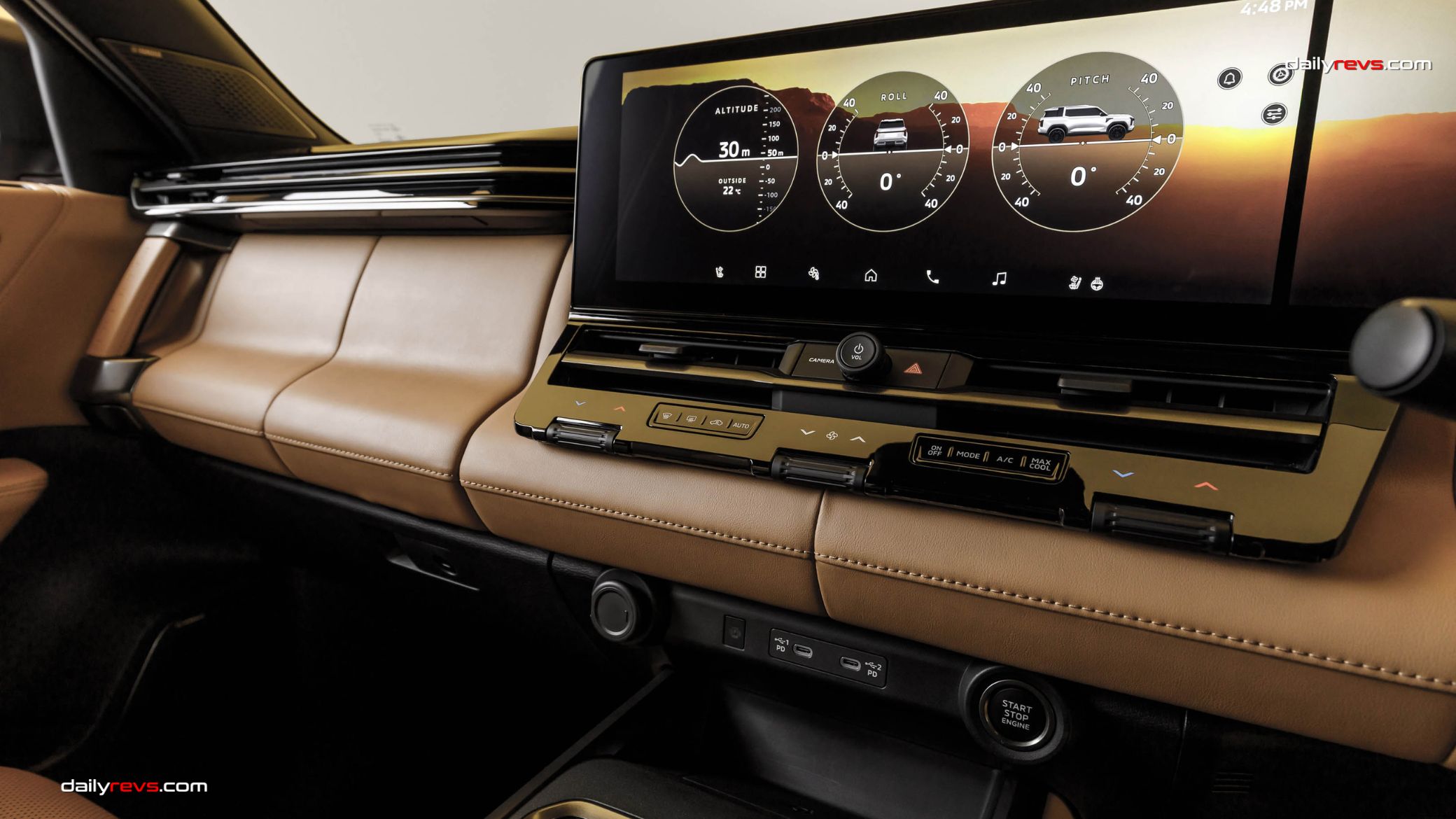
One old Pajero feature has returned in a particularly satisfying way. The triple meter. Auxiliary gauges mounted prominently above the dashboard became familiar features in earlier Pajeros. Mitsubishi has now rebuilt the idea digitally as the Multi Meter. It can show altitude, compass direction and ambient temperature along with pitch and roll. Other displays provide information relating to the four-wheel-drive system and torque distribution.
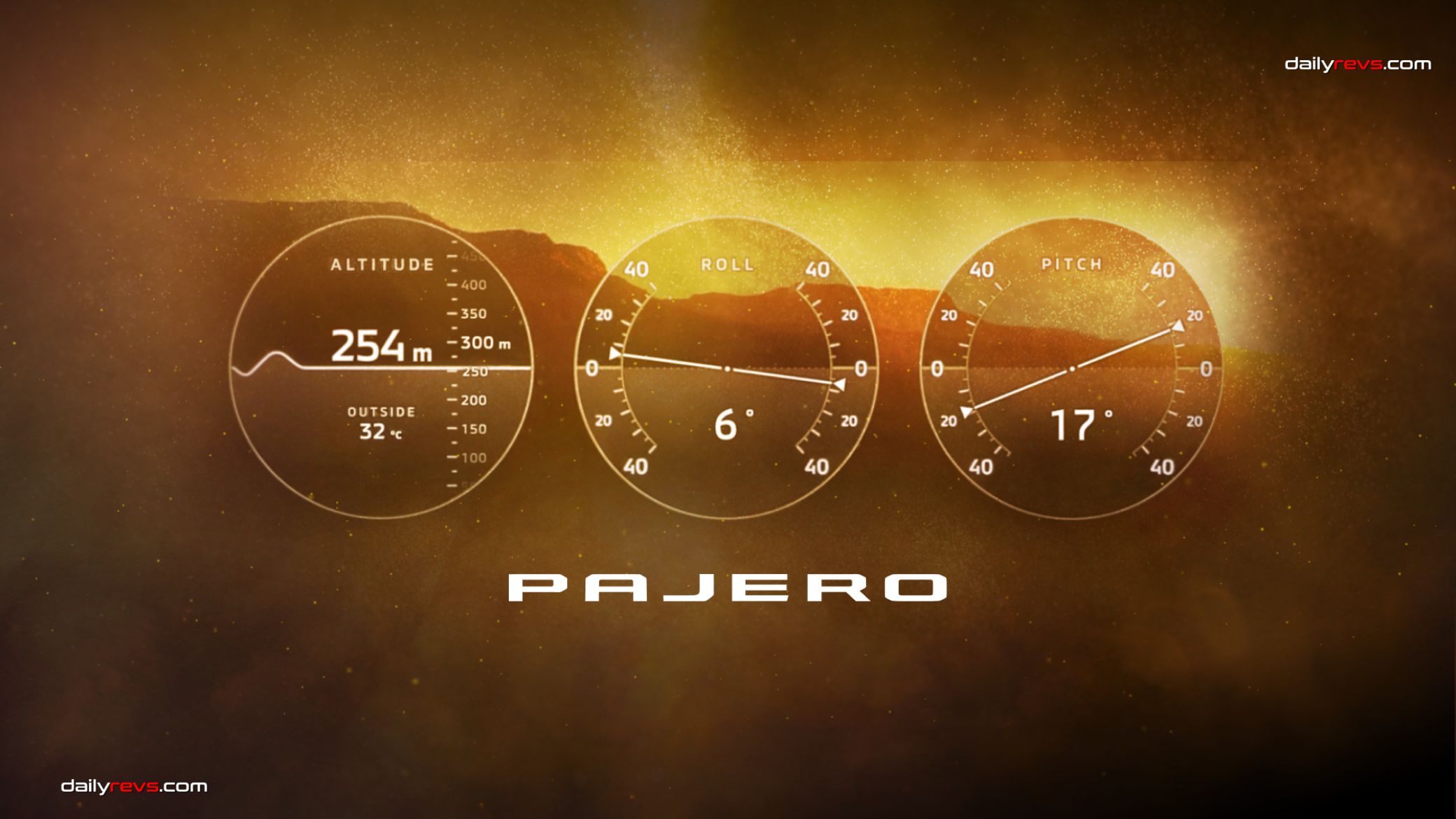
There is an obvious visual connection with the old triple gauges, but the information remains useful. That makes the Multi Meter different from putting a fake analogue clock on the dashboard or drawing an old instrument face onto a digital screen. The technology changed. The purpose survived. It is a small feature, but it probably explains Yoshimine's approach to the entire vehicle better than any design slogan could.
How the Pajero compares on paper
Australian specifications provide one of the first opportunities to compare the new Mitsubishi directly with its main competitors.
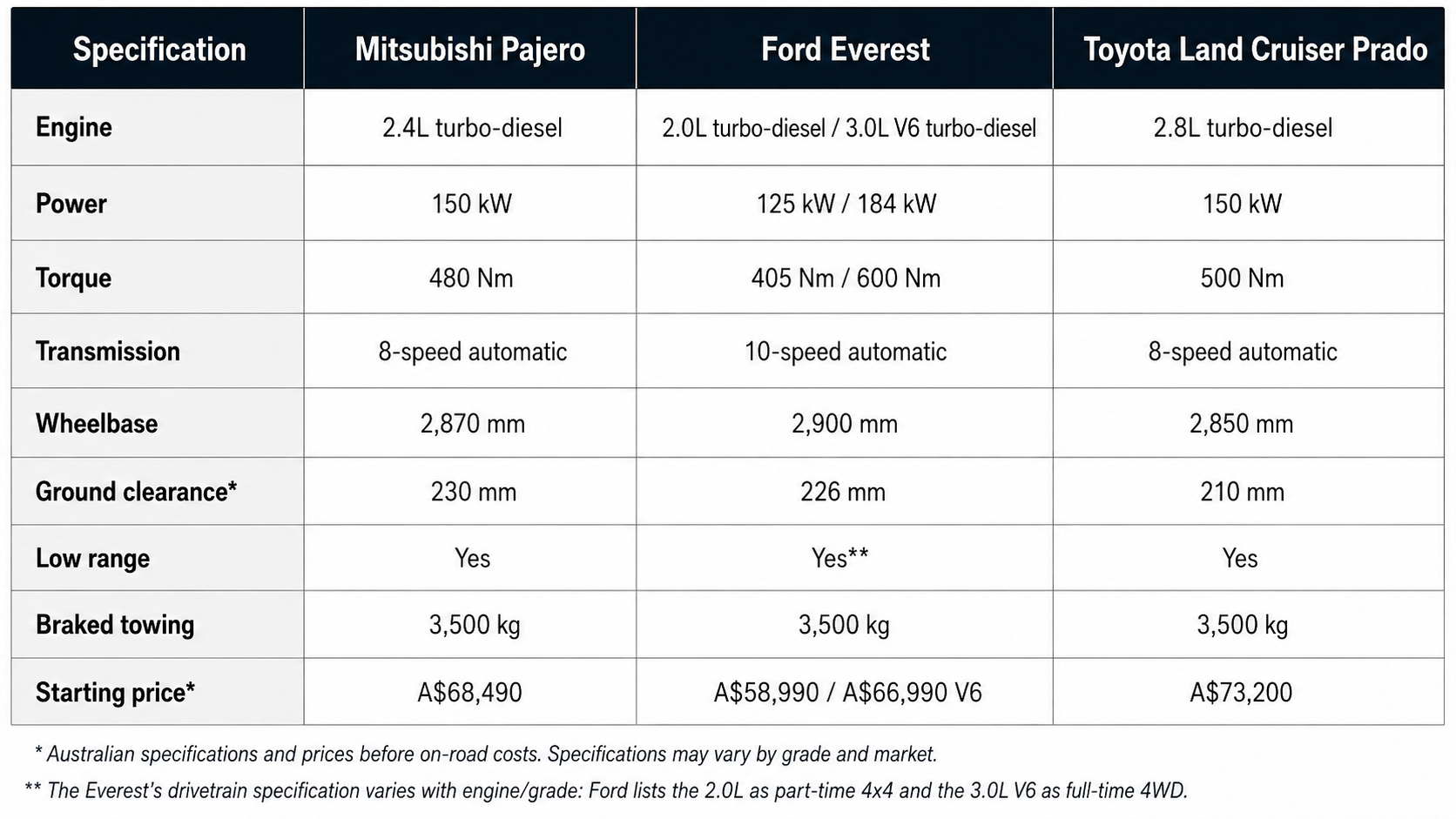
*Australian specifications and pricing.
Clearance varies by variant and market.
The Pajero doesn't dominate that table. It isn't supposed to. The Everest V6 has substantially more power and torque. Prado arrives with the Land Cruiser reputation and Toyota's enormous global support network. Everest has already established itself as one of the strongest vehicles in this class. Mitsubishi counters with Super Select 4WD-II, competitive dimensions and off-road geometry, strong standard equipment and a price that slots between Everest and Prado.
The specification sheet gets the Pajero into the conversation. Its name is what makes the conversation interesting.
A reputation built somewhere other than a showroom
A reputation the new Pajero cannot inherit Few people have a better perspective on the Pajero than Hiroshi Masuoka. He raced and helped develop them, won the Dakar twice with Mitsubishi and has owned examples from every generation. In Mitsubishi's recent series looking back at the Pajero, Masuoka talks about trust in personal terms: the confidence to put someone important to you in the vehicle and know it will bring them home. Mitsubishi describes that quality as being “entrusted.” It could sound like advertising, but four decades of Pajero history give the idea some substance.
Dakar supplied the spectacular part, with 12 victories demonstrating what Mitsubishi could achieve in extreme conditions. The road-going reputation was built more slowly by millions of owners. Pajeros became family cars, tow vehicles, expedition trucks and everyday transport. They were modified, worked hard and used in places where roads could be punishing. Some also entered government and institutional fleets. That accumulated experience became part of what the Pajero name meant. Mitsubishi can reproduce many of the ingredients. The ladder frame and low range are back.
Yoshimine's design team has translated the original roll bar into the new C-pillar, turned the familiar rear spare wheel into a graphic and reimagined the old triple gauges as a digital Multi Meter. The vehicle also arrives during the broader rebuilding of Mitsubishi's design identity under leadership that includes Executive Design Director Alessandro Dambrosio. Its pricing puts it among serious competition, too. The Ford Everest is well established, the Land Cruiser Prado never left, and the Fortuner remains important in many markets where the Pajero will be sold. What Mitsubishi cannot provide at launch is the reputation previous Pajeros accumulated over decades. Millions of people already have an idea of what a Pajero should be. The fifth generation inherits the name. The reputation it will have to earn for itself.
Sources : Mitsubishi Japan