McLaren Short Tail Concept Prioritizes Agility Over Power
By Hugo Mattson June 30, 2025

A compact, track focused McLaren concept designed for agility and authenticity.
Inspired by F1 hybrid tech, the proposed V6 engine prioritizes power to weight efficiency.
Designed by Joshua Roberts, this study reshapes McLaren's future performance narrative through proportion and purpose.
Reframing Performance: The Essence of the McLaren Short Tail
The McLaren Short Tail concept by designer Joshua Roberts is an exploration in recalibrating performance philosophy. Unlike typical hypercars that chase top speeds and exaggerated figures, Roberts’ concept investigates how design and packaging can reorient McLaren’s focus toward driver engagement, footprint efficiency, and mechanical clarity. This study proposes a McLaren that achieves its character through restraint, not excess.

Full Gallery of the Mclaren Short Tail can be found right at the end of this article.
A New Direction for the Series
According to Roberts, "This concept is the first McLaren in its series to offer track level performance at a compact size. The new Short Tail series aims to prioritise agility over speed, targeting a user audience seeking an unfiltered and authentic experience."
In that statement lies the ideological backbone of the car. Rather than seeking lap time superiority through brute force, the Short Tail concept opts for better packaging, weight control, and responsiveness. It represents an architectural shift, where proportions tighten and surfaces become more athletic than expressive.
Powertrain Rooted in Formula 1 Efficiency
The vision for the car’s powertrain is equally considered. Roberts outlines his ideal engine as the V6 hybrid developed under McLaren’s Formula 1 program, specifically smaller and more efficient than the 3.0L V6 in the Artura. The objective is clear: reduced packaging volume, improved weight distribution, and a better power to weight ratio.
This approach suggests a future where performance is refined through engineering efficiency, not sheer output. A compact hybrid power unit is both a technical advantage and a statement of intent—focused, disciplined, and appropriate for the scale of the vehicle.
Packaging, Surface, and Intent: A Design Analysis
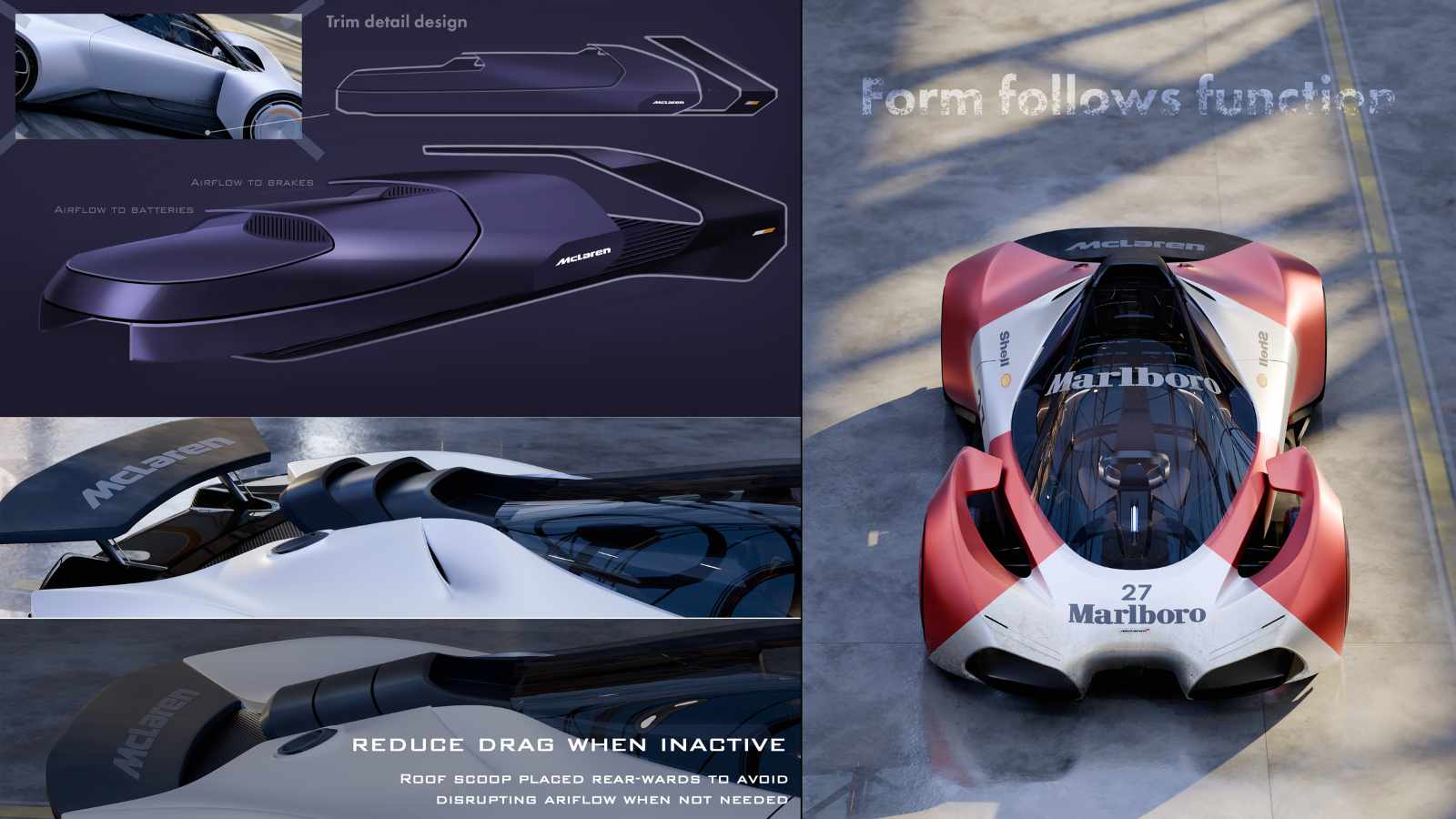
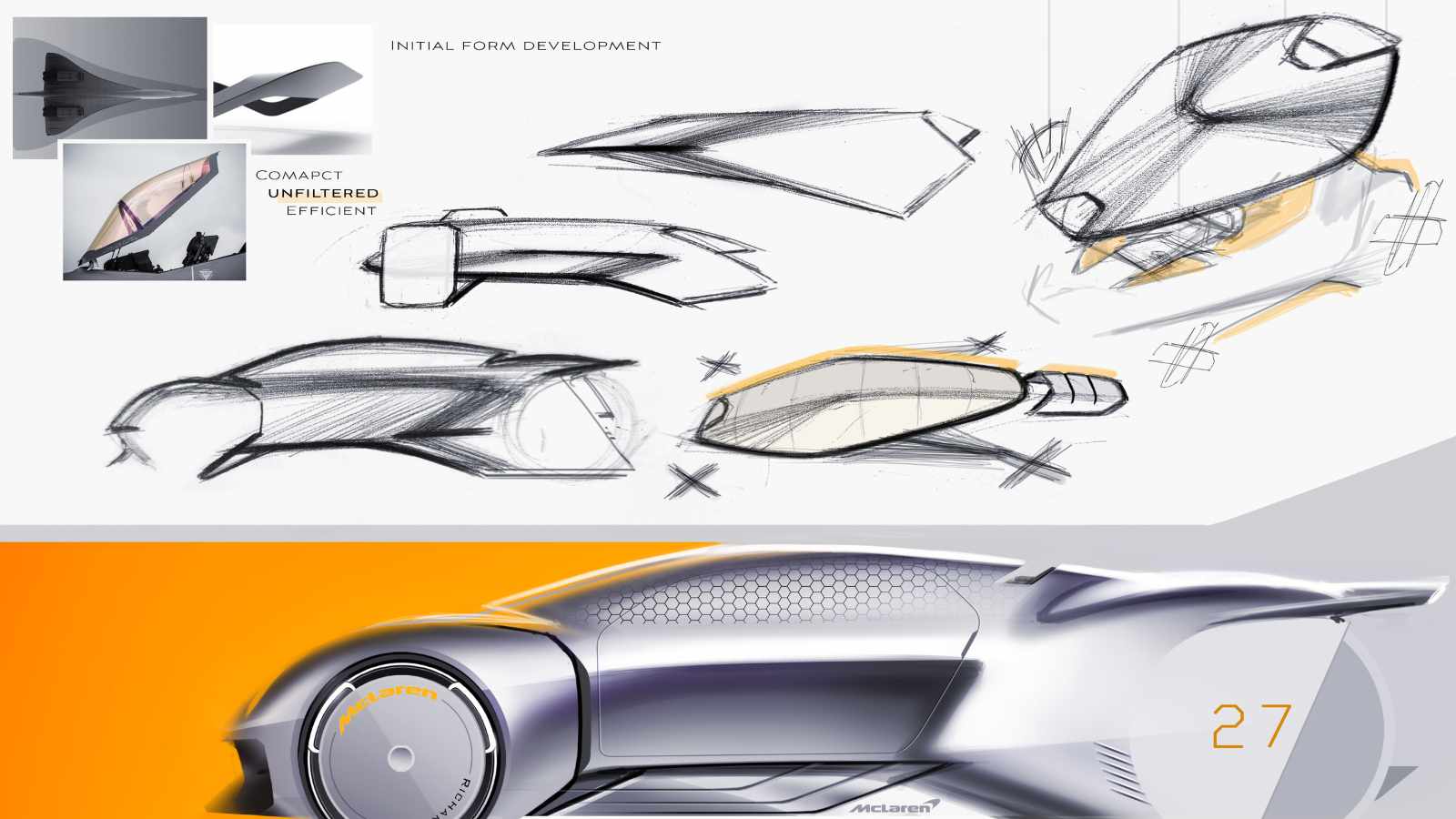
The collection of sketches and renders makes it evident that Roberts has pursued a body architecture driven by function. Overhangs are minimized. Surfaces are clean. The front is low and sculpted with integrated air channels. A subtle homage to the McLaren F1 appears on the upper reference panel, connecting the Short Tail to its historical roots without direct imitation.
In plan view, the body tapers into a form reminiscent of a teardrop—narrow at the rear, balanced at the center, and pointed at the nose. The deck is restrained, allowing the rear volume to serve aerodynamic performance rather than decorative drama. The canopy, shaped like a streamlined pod, is aeronautical in tone but grounded in purpose.
Active aerodynamics play a functional role in the design. A deployable scoop adapts airflow to reduce drag and manage thermal loads across battery and brake systems. The system is diagrammed clearly in the design board, showcasing a layout made for high performance operation rather than static display.
Form Language and Visual Weight
Rendered surfaces sweep with continuity across the body. There are no aggressive slashes or complex cut lines. The car’s mass is managed through soft transitions and proportional control rather than contrast or exaggeration.
Wheel arches are substantial but not dominant, framing a cockpit that sits low and central. From overhead, the circular wheel covers emphasize geometric clarity and reduce visual clutter. The result is a chassis that feels taut and composed.

Positioning the Short Tail Within McLaren’s Legacy
While the Longtail series explored how extended forms could yield aerodynamic benefits, the Short Tail reverses that logic. It presents a reductionist strategy—shorter dimensions, lighter packaging, and an emphasis on agility. It does not reference the past as a design language. It acknowledges it, then charts a different path.
This change in direction may hint at an evolving McLaren philosophy, where the definition of performance broadens to include responsiveness, usability, and spatial economy.
A Designer Shaping Tomorrow’s Dynamics
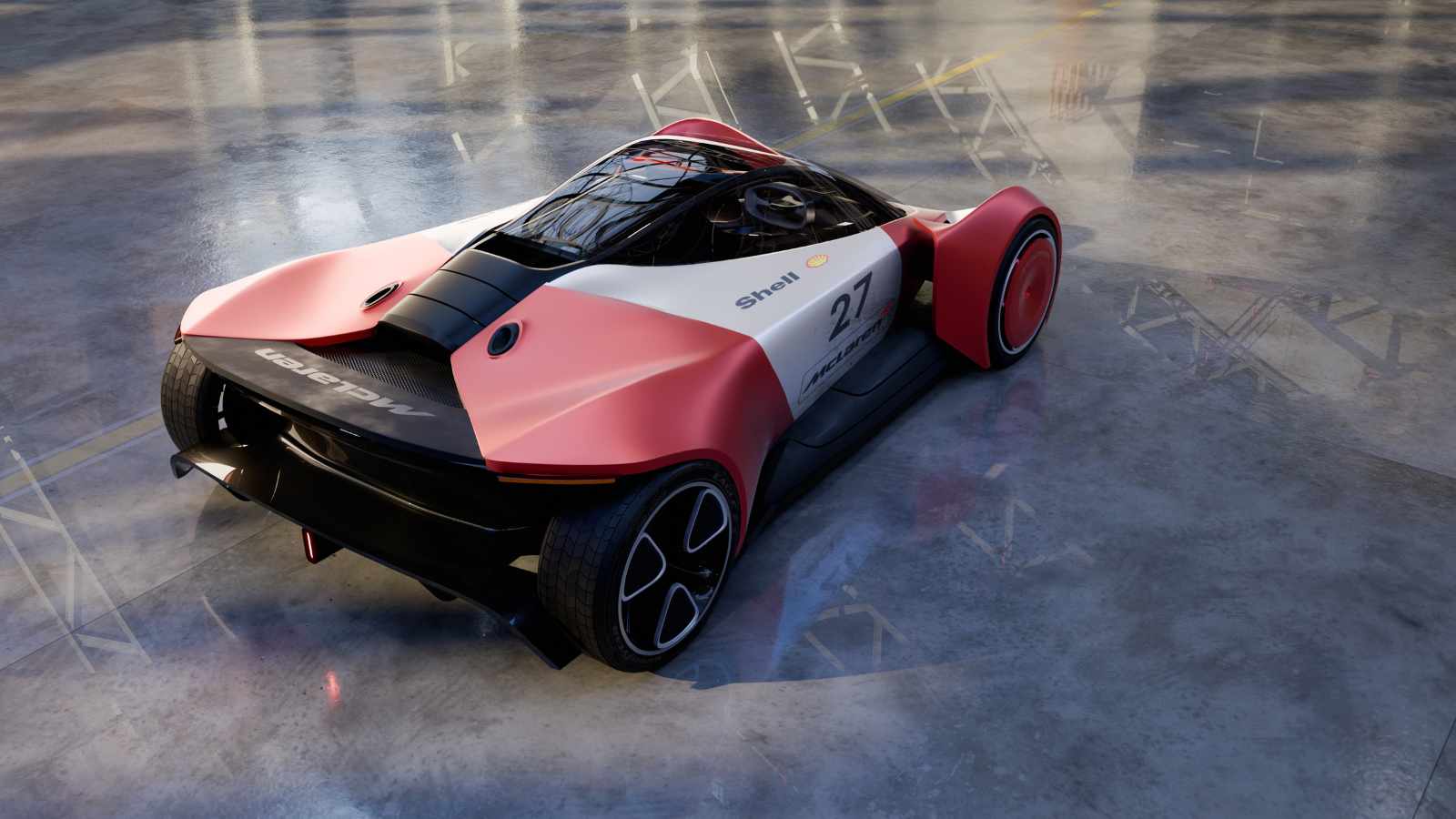
Joshua Roberts’ vision for the McLaren Short Tail is clear in its intention and mature in execution. Every proportion, every surface, and every proposed component is considered in the context of experience. This is a concept car that goes beyond styling exercise. It reads as a platform strategy—ready for refinement, but already believable.
Contextual Comparison: AMG ONE and Solus GT
In today’s hypercar landscape, comparisons are inevitable. Two notable benchmarks include the 2023 Mercedes-Benz AMG ONE and the 2023 McLaren Solus GT. Both are extreme interpretations of track capability, pushing boundaries with complex aerodynamic systems, Formula 1 powertrains, and high-spec material strategies.
Yet, what sets the McLaren Short Tail apart is visual clarity and proportion control. Unlike the AMG ONE’s heavily ventilated surfaces or the Solus GT’s layered aggression, the Short Tail maintains a disciplined design philosophy. Its aerodynamic solutions are integrated, not expressed. The car feels unified—more composed, less fragmented.
This coherence reflects a level of authorship where the designer retains control over complexity. It suggests that performance doesn’t have to mean visual overload. Instead, as Roberts’ work shows, it can mean refinement, legibility, and focus.
Please check out Joshua Roberts' design Projects here : Behance
Follow him on Instagram : corrupt_file
Disclaimer: These works are not affiliated with the official efforts of OEM design studios. They are independent reflections of the creative minds of young car designers whose voices deserve to be heard. DailyRevs does not claim any credit for the effort or vision behind these projects. We do not receive financial compensation for publishing such work. These features are shared only with the consent of the designers, after direct outreach and agreement. We also welcome submissions from designers who wish to be featured, provided the quality of the work meets editorial standards.


